

TOEFL
Test of English as a Foreign Language
Test of English as a Foreign Language (TOEFL) is a standardized test to measure the English language ability of non-native speakers wishing to enroll in English-speaking universities. The test is accepted by many English-speaking academic and professional institutions. TOEFL is one of the two major English-language tests in the world, the other being the IELTS. TOEFL is a trademark of the Educational Testing Service (ETS), a private non-profit organization, which designs and administers the tests. ETS issues official score reports, sent independently to institutions, for two years following the test
Internet-based test
Since its introduction in late 2005, the TOEFL Internet-based Test (iBT) format has progressively replaced the computer-based tests (CBT) and paper-based tests (PBT), although paper-based testing is still used in select areas. The TOEFL iBT test has been introduced in phases, with the United States, Canada, France, Germany, and Italy in 2005 and the rest of the world in 2006, with test centers added regularly. The CBT was discontinued in September 2006 and these scores are no longer valid[citation needed]. Initially, the demand for test seats was higher than availability, and candidates had to wait for months. It is now possible to take the test within one to four weeks in most countries.[9] The four-hour test consists of four sections, each measuring one of the basic language skills (while some tasks require integrating multiple skills), and all tasks focus on language used in an academic, higher-education environment. Note-taking is allowed during the TOEFL iBT test. The test cannot be taken more than once every 12 days
1.Reading
The Reading section consists of questions on 3-5 passages, each approximately 700 words in length
2.Listening
The Listening section consists of questions on six passages, each 3–5 minutes in length. These passages include two student conversations and four academic lectures or discussions.
3.Speaking
The Speaking section consists of six tasks: two independent and four integrated.
4.Writing
The Writing section measures a test taker's ability to write in an academic setting and consists of two tasks: one integrated and one independent. In the integrated task, test-takers read a passage on an academic topic and then listen to a speaker discuss it.
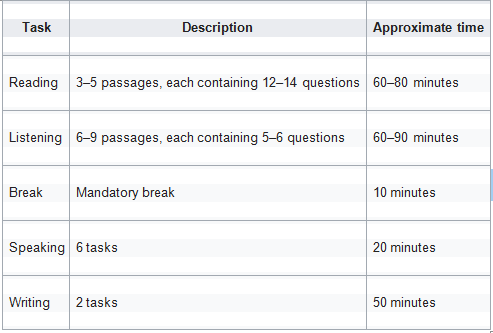 One of the sections of the test will include extra, uncounted material. Educational Testing Service includes extra material to pilot test questions for future test forms. When test-takers are given a longer section, they should give equal effort to all of the questions because they do not know which question will count and which will be considered extra. For example, if there are four reading passages instead of three, then one of the passages will not be counted. Any of the four could be the uncounted one.
Internet-based test
The TOEFL® paper-based Test (PBT) is available in limited areas. Scores are valid for two years after the test date, and test takers can have their scores sent to institutions or face time.
1.Listening (30 – 40 minutes)
The Listening section consists of 3 parts. The first one contains 30 questions about short conversations. The second part has 8 questions about longer conversations. The last part asks 12 questions about lectures or talks.
2.Structure and Written Expression (25 minutes)
The Structure and Written Expression section has 15 exercises of completing sentences correctly and 25 exercises of identifying errors.
3.Reading Comprehension (55 minutes)
The Reading Comprehension sections has 50 questions about reading passages.
4.Writing (30 minutes)
The TOEFL PBT administrations include a writing test called the Test of Written English (TWE). This is one essay question with 250–300 words in average.